


The Leaders & Laggards of LGBTQ+ Rights in Europe
This article is published in collaboration with Statista
by Anna Fleck
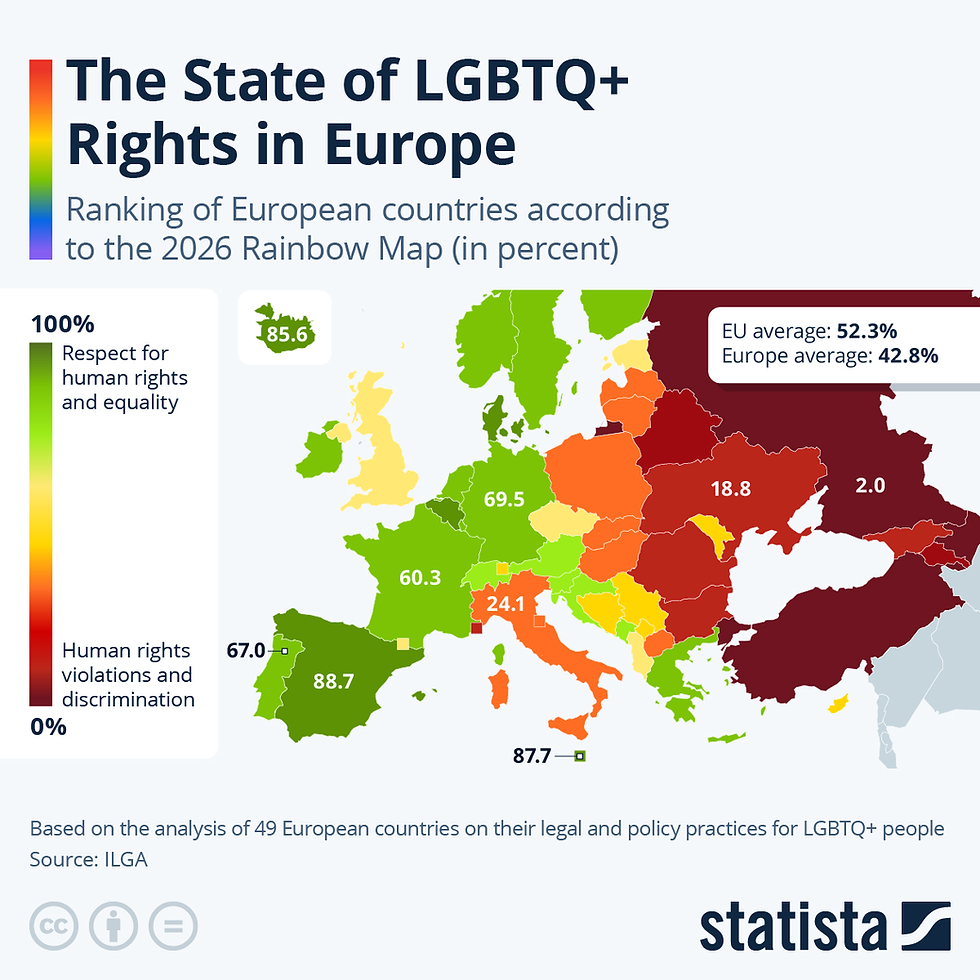
The International Lesbian, Gay, Bisexual, Trans and Intersex Association (ILGA) has published its annual Rainbow Map, which assesses the legal and policy practices of 49 European countries for LGBTQ+ people. And this year, Spain broke Malta's decade-long hold on the top spot. Spain received a score of 88.7 out of a possible 100 percent this year, based on the analysis of criteria such as equity and non-discrimination, family, hate crimes and expressions, legal gender recognition and asylum. "Spain’s number one ranking is a strong example of what becomes possible when a government makes a deliberate choice to advance equality rather than retreat from it" said Katrin Hugendubel, Deputy Director of ILGA-Europe, in the press release accompanying this year's ranking. The Spanish government has implemented its legally binding commitments from 2023 by adopting action plans for LGBTQ+ rights equality, establishing an independent equal treatment authority, and fully implementing the depathologization of transgender people within the healthcare system, the report continues.
This year, Spain is followed by long-term number one Malta, which received a score of 87.73 percent, slightly less than last year (88.8 percent), then Iceland, Belgium and Denmark, all with scores above 80 percent. At the other end of the spectrum, Armenia, Belarus, Turkey, Azerbaijan and Russia received the worst scores, all below 10 percent. Romania sits at the bottom of the EU ranking, with a score of 18.63 percent. The United Kingdom saw its score drop again this year, from 45.65 percent to 43.9 percent. The UK's grade has been declining since 2015, when it held the top spot in the ranking with a score of 86 percent, before the continued attacks on trans rights saw the country's situation slowly degrade. In order to improve the legal and policy situation of LGBTQ+ people in United Kingdom, ILGA-Europe recommends that the UK ensure timely and accessible trans-specific healthcare, including addressing excessive waiting times and restoring access to puberty blockers for trans youth outside restrictive research frameworks; ensure that trans people can obtain effective legal gender recognition, including recognition of trans parenthood, and that the treatment of trans people is fully compliant with the ECHR; and ban conversion practices on the grounds of sexual orientation and gender identity.
ILGA-Europe highlights that as of 2026, marriage equality is only available 22 of the 49 European countries analysed. Within those same countries, 18 don't have any protections of same-sex couples, and 7 do not have any legal protection from discrimination based on sexual orientation, gender identity and expression, and sex characteristics. Conversion practices are only banned in 10 countries, while hate crime and hate speech on the grounds of sexual orientation, gender identity, and sex characteristics are only prohibited in Belgium, Denmark, Greece, Iceland, Malta and some regions of Spain and the UK.
Start leaning Data Science and Business Intelligence tools:


Comments